918Kiss Blackjack Guide: Rules & Basic Strategy
Published: 3 November 2026 · Reviewed by the M-Kiss918 editorial team
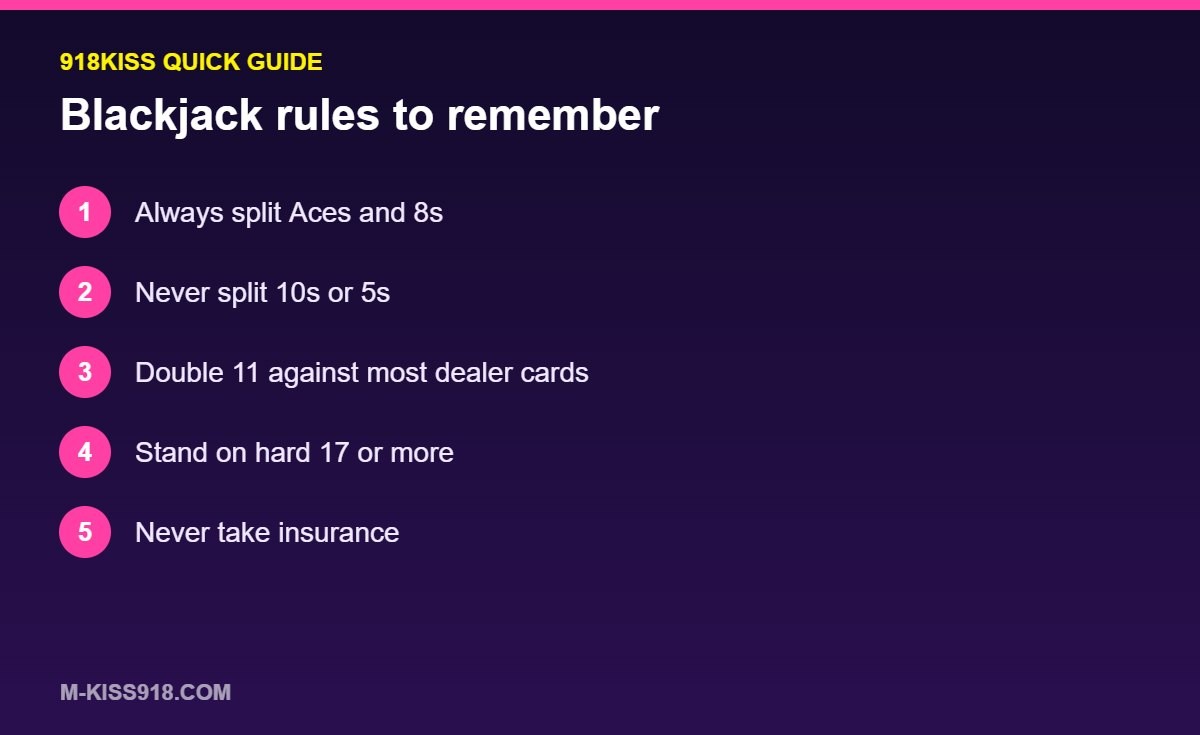
Quick answer: Blackjack is the most skill-based game on 918Kiss. You aim to beat the dealer's hand without going over 21. Following basic strategy – the mathematically best decision for every hand – keeps the house edge low, often around 0.5–1% depending on table rules. Key rules: always split Aces and 8s, never split 10s or 5s, double 11 against most dealer cards, stand on hard 17 or more, and never take insurance.
Most casino games give you no real decisions. Blackjack does – and those decisions matter. Two players at the same 918Kiss blackjack table, with the same cards, can have very different results depending on whether they hit, stand, double or split correctly. This guide teaches the rules, the core of basic strategy and the common mistakes that turn a low-edge game into an expensive one. Before you begin, make sure you have the genuine Kiss918 APK rather than a modified copy.
Blackjack Rules in Brief
| Element | Rule |
|---|---|
| Goal | Get closer to 21 than the dealer without going over |
| Card values | 2–10 at face value; J, Q, K = 10; Ace = 1 or 11 |
| Blackjack | Ace + 10-value card on the first two cards; usually pays 3:2 |
| Dealer | Must hit until reaching a set total (commonly 17) |
| Bust | Going over 21 loses immediately, even if the dealer later busts |
Your options on each hand
| Option | What it does | When it is useful |
|---|---|---|
| Hit | Take another card | When your total is low or the dealer shows strength |
| Stand | Keep your total | When the dealer is likely to bust or your total is strong |
| Double | Double your bet, take exactly one card | On strong starting totals like 10 or 11 |
| Split | Split a pair into two hands with equal bets | On pairs such as Aces or 8s |
| Insurance | Side bet when dealer shows an Ace | Almost never worth it |
Hard and Soft Hands
A hard hand has no Ace, or an Ace that must count as 1 (e.g. 10-6 = hard 16). A soft hand has an Ace counted as 11 (e.g. Ace-6 = soft 17). Soft hands cannot bust on the next card, which is why basic strategy plays them more aggressively.
Basic Strategy: The Core Rules
These simplified rules cover most hands in a standard multi-deck game where the dealer stands on soft 17. Always check the table rules in your app.
Hard totals
| Your hand | Dealer 2–3 | Dealer 4–6 | Dealer 7–Ace |
|---|---|---|---|
| 8 or less | Hit | Hit | Hit |
| 9 | Hit | Double (else hit) | Hit |
| 10 | Double | Double | Double vs 7–9; hit vs 10–Ace |
| 11 | Double | Double | Double (hit vs Ace in some rule sets) |
| 12 | Hit | Stand | Hit |
| 13–16 | Stand | Stand | Hit |
| 17 or more | Stand | Stand | Stand |
Soft totals
| Your hand | Recommended play |
|---|---|
| Soft 13–15 (A-2 to A-4) | Hit; double vs dealer 5–6 if allowed |
| Soft 16–17 (A-5, A-6) | Hit; double vs dealer 3–6 or 4–6 if allowed |
| Soft 18 (A-7) | Stand vs 2, 7, 8; double vs 3–6; hit vs 9–Ace |
| Soft 19 or more | Stand |
Pairs
| Pair | Play |
|---|---|
| Aces | Always split |
| 8s | Always split |
| 10s | Never split – stand |
| 5s | Never split – treat as 10 and double vs 2–9 |
| 2s, 3s, 7s | Split vs dealer 2–7 |
| 6s | Split vs dealer 2–6 |
| 9s | Split vs 2–6 and 8–9; stand vs 7, 10, Ace |
| 4s | Split only vs 5–6 if doubling after split is allowed; otherwise hit |
Why Insurance Is a Bad Bet
When the dealer shows an Ace, you will be offered insurance – a side bet that the dealer has blackjack. It pays 2:1, but the true odds of the dealer having a 10-value card are worse than that, giving the bet a high house edge. Unless you are counting cards in a physical game (not practical in digital blackjack), always decline.
Table Rules That Change the Edge
| Rule | Better for player | Worse for player |
|---|---|---|
| Blackjack payout | 3:2 | 6:5 |
| Dealer on soft 17 | Stands | Hits |
| Doubling | Any two cards, after split | Only on 10–11 |
| Number of decks | Fewer | More |
| Surrender | Offered | Not offered |
A 6:5 blackjack payout is one of the most costly rule changes and can raise the house edge significantly. Prefer 3:2 tables whenever possible.
Common Blackjack Mistakes
| Mistake | Why it costs money |
|---|---|
| Standing on 12–16 against a dealer 7–Ace | Dealer is likely to make a strong hand |
| Never doubling | Misses the most profitable situations |
| Splitting 10s | Breaks up a very strong 20 |
| Taking insurance | High-edge side bet |
| "Mimicking the dealer" (always hitting to 17) | Ignores dealer bust chances |
A Blackjack Session Plan
Start with a budget such as RM100 and flat bets of RM2–RM5. Keep a basic strategy table open on another screen or printed out. Set a stop-loss at RM50 and a stop-win at RM160, and limit sessions to around 45 minutes. Because blackjack has the most real decisions, fatigue hurts results more than in other games – take breaks.
Practising Basic Strategy
Memorising every cell of a strategy table takes time. A step-by-step approach works best:
- Week 1 – Hard totals only. Learn when to hit or stand on 12–16, and to double 10 and 11. These cover most hands you will see.
- Week 2 – Pairs. Remember the four anchors: always split Aces and 8s, never split 10s and 5s.
- Week 3 – Soft hands. Focus on soft 17 and soft 18, the two most commonly misplayed.
- Week 4 – Review. Play with a test ID and check each decision against your table.
Most players find that after a few weeks, the correct play becomes automatic for the common situations.
Example Hands Explained
| Hand | Dealer shows | Correct play | Reason |
|---|---|---|---|
| 10-6 (hard 16) | 10 | Hit | Dealer likely has 20; standing loses most of the time |
| 10-6 (hard 16) | 5 | Stand | Dealer has a high chance of busting |
| A-7 (soft 18) | 9 | Hit | Soft 18 is weaker than it looks against a strong dealer card |
| 8-8 | 10 | Split | Two hands starting with 8 beat one hand of 16 |
| 6-5 (hard 11) | 6 | Double | Excellent chance of a strong total vs a weak dealer card |
Why Blackjack Rewards Patience
Blackjack's low edge only applies if you play every hand correctly. A few emotional decisions – standing on 16 against a 10 because you "have a feeling", or doubling a soft 13 against a 10 – can quickly cost more than the edge itself. Slow down, consult your table and treat each hand as a fresh decision.
Blackjack FAQ
Is blackjack on 918Kiss based on skill?
Partly. Cards are random, but correct decisions using basic strategy significantly lower the house edge.
Should I always split Aces and 8s?
Yes. Basic strategy recommends always splitting Aces and 8s.
Is insurance worth taking in blackjack?
No. Insurance has a high house edge and should generally be declined.
What is the house edge in 918Kiss blackjack?
With basic strategy and good rules it can be around 0.5–1%, but it depends on the specific table rules.
When should I double down?
Commonly on hard 10 or 11 against most dealer cards, and on some soft hands against weak dealer cards.